Are you in need of an extra dose of motivation to push through your CrossFit workouts? Look no further! In this blog post, I’ve curated a list of 100 motivational CrossFit quotes that will help ignite the fire within you and push you to reach new heights in your fitness journey.
These quotes are not just mere words; they are powerful reminders of the mental and physical strength required to excel in the sport of CrossFit.
Whether you’re a seasoned CrossFit athlete or someone just starting out, these quotes will inspire you to conquer your fears, embrace the pain, and push beyond your limits.
CrossFit is more than just a workout; it’s a lifestyle that demands dedication, perseverance, and a mindset of continuous improvement.
In this carefully compiled list, you’ll find quotes from famous athletes, insightful sayings from CrossFit coaches, and timeless words of wisdom that will fuel your determination and keep you focused on your goals.
These quotes touch on various aspects of the CrossFit experience, from overcoming obstacles to the importance of community support.
As you read through these quotes, reflect on how they resonate with you and consider how they can impact your mindset during workouts when faced with difficult challenges, and in your day-to-day life.
The power of motivation lies in the ability to fuel your drive and keep you going, even when the going gets tough.
So, are you ready to tap into your inner athlete and unleash the full potential of your CrossFit journey?
Let’s dive into this collection of 100 motivational CrossFit quotes that will inspire, empower, and push you to be the best version of yourself.
Get ready to harness the power of these words and let them fuel your determination as you conquer new heights in your fitness journey.
Get your head right, strap on your lifting shoes, and prepare to be inspired as we explore these powerful words of motivation. Let’s dive into the world of CrossFit and ignite the fire within!
“A champion is someone who gets up when they can’t.” – Jack Dempsey
“Pain is temporary. Quitting lasts forever.” – Lance Armstrong
“Doubt me, hate me, you’re the inspiration I need.” – Conor McGregor
“Success isn’t given. It’s earned. On the track, on the field, in the gym. With blood, sweat, and the occasional tear.” – Nike
“The body achieves what the mind believes.” – Unknown
“Lift heavy, lift often.” – Unknown
“If it doesn’t challenge you, it doesn’t change you.” – Fred DeVito
“Rise and grind.” – Unknown
“Your only limit is you.” – Unknown
“Train like a beast, look like a beauty.” – Unknown
“Don’t stop when it hurts, stop when you’re done.” – Unknown
“Be proud, but never satisfied.” – Unknown
“Stronger than yesterday.” – Unknown
“The clock doesn’t lie.” – Unknown
“No pain, no gain.” – Unknown
“Sweat is fat crying.” – Unknown
“Your body can do anything. It’s your mind you have to convince.” – Unknown
“Be relentless in the pursuit of your goals.” – Unknown
“Clear your mind of can’t.” – Unknown
“The only workout you regret is the one you didn’t do.” – Unknown
“Embrace the pain, it’s the only way to grow.” – Unknown
“There are no shortcuts to any place worth going.” – Unknown
“The harder the battle, the sweeter the victory.” – Les Brown
“Strength doesn’t come from what you can do. It comes from overcoming what you once thought you couldn’t.” – Rikki Rogers
“The pain you feel today will be the strength you feel tomorrow.” – Unknown
“If it’s raining, bring an umbrella. If it’s not raining, what’s your excuse?” – Unknown
“When you feel like quitting, think about why you started.” – Unknown
“The only way to finish is to start.” – Unknown
“You don’t always get what you wish for, but you always get what you work for.” – Unknown
“Don’t count the days, make the days count.” – Unknown
“It’s supposed to be hard. If it wasn’t hard, everyone would do it. The hard is what makes it great.” – Tom Hanks
“The pain of discipline is far less than the pain of regret.” – Sarah Bombell
“The only bad workout is the one you didn’t do.” – Unknown
“Believe in yourself and all that you are. Know that there is something inside you that is greater than any obstacle.” – Christian D. Larson
“Success is not the result of spontaneous combustion. You must set yourself on fire.” – Reggie Leach
“You don’t have to be great to start, but you have to start to be great.” – Zig Ziglar
“The greatest adaptation of CrossFit is between the ears.” – Pat Sherwood
“It’s not about being the best. It’s about being better than you were yesterday.” – Unknown
“It’s not about the weight you lift, but the weight you feel lifted off your shoulders after a tough workout.” – Unknown
“I do CrossFit because I can, because I’m able, and because I want to be better than I was yesterday.” – Unknown
“Keep going until you’re proud.” – Unknown
“The real workout starts when you want to stop.” – Unknown
“Sweat is just fat crying.” – Unknown
“The only thing standing between you and your goals is the story you keep telling yourself.” – Unknown
“Fail, learn, grow, repeat.” – Unknown
“Your mind will quit a thousand times before your body will. Feel the pain and do it anyway.” – Unknown
“The best way to predict your future is to create it.” – Peter Drucker
“Don’t watch the clock, do what it does. Keep going.” – Sam Levenson
“Your strength comes from the pain you push through.” – Unknown
“Beast mode: ON.” – Unknown
“Don’t wish for it, work for it.” – Unknown
“You are stronger than you think.” – Unknown”
The difference between the impossible and the possible lies in a person’s determination.” – Tommy Lasorda
“Success is no accident. It is hard work, perseverance, learning, studying, sacrifice, and most of all, love of what you are doing or learning to do.” – Pelé
“Train hard and your body will follow.” – Unknown
“If you want something you’ve never had, you must be willing to do something you’ve never done.” – Thomas Jefferson
“The only bad workout is the one you didn’t show up for.” – Unknown
“Your body is capable of amazing things. It’s your mind you have to convince.” – Unknown
“The pain you feel today will be the strength you feel tomorrow.” – Unknown
“Winners don’t wait for chances, they take them.” – Unknown
“Success is not just about hitting PRs. It’s about pushing your limits and doing things you never thought possible.” – Unknown
“Chase your dreams, crush your goals.” – Unknown
“Pain is temporary, pride is forever.” – Unknown
“Every day is a new chance to get stronger, to eat better, to live healthier, and to be the best version of yourself.” – Unknown
“You don’t have to be first, you just have to finish.” – Unknown
“The struggle you’re in today is developing the strength you need for tomorrow.” – Unknown
“Don’t stop when you’re tired. Stop when you’re done.” – Unknown
“Strength doesn’t come from what you can do. It comes from overcoming the things you once thought you couldn’t.” – Unknown
“Every champion was once a contender that refused to give up.” – Rocky Balboa
“Be the hardest-working person you know.” – Unknown
“You don’t get what you wish for, you get what you work for.” – Unknown
“The greatest pleasure in life is doing what people say you cannot do.” – Unknown
“Life is tough. But so are you.” – Unknown
“Success is the sum of small efforts, repeated day in and day out.” – Robert Collier
“Make your dreams as loud as your workout playlist.” – Unknown
“The best athletes are made in the off-season.” – Unknown
“One man has enthusiasm for 30 minutes, another for 30 days, but it is the man who has it for 30 years who makes a success out of his life.” – Edward B. Butler
“The struggle you’re in today is the strength you need for tomorrow.” – Unknown
“I may not be the strongest, I may not be the fastest, but you can bet I’ll be the one working the hardest.” – Unknown
“Tough times never last, but tough people do.” – Robert H. Schuller
“The only time you should ever look back is to see how far you’ve come.” – Unknown
“If it doesn’t challenge you, it doesn’t change you.” – Unknown
“The pain of discipline is nothing compared to the pain of regret.” – Unknown
“Be humble, be hungry, and always be the hardest worker in the room.” – Dwayne Johnson
“You have to believe in yourself when no one else does. That’s what makes you a winner.” – Venus Williams
“The CrossFit community is a family united by pain, sweat, and the pursuit of greatness.” – Unknown
“You’re only one workout away from a good mood.” – Unknown
“Don’t stop until you’re proud.” – Unknown
“Set goals, crush them, and repeat.” – Unknown
“You are stronger than you think you are. Rise above the pain and conquer.” – Unknown
“The human body is capable of amazing physical deeds. If we could just free ourselves from our perceived limitations and tap into our internal fire, the possibilities are endless.” – Dean Karnazes
“Your body can stand almost anything. It’s your mind that you have to convince.” – Unknown
“I am the creator of my destiny and the chief architect of my success.” – Unknown
“You don’t find willpower, you create it.” – Unknown
“The pain you feel today will be the strength you feel tomorrow.” – Unknown
“Obsessed is how the lazy describe the dedicated.” – Unknown
“Your body is the only place you have to live. Take care of it.” – Jim Rohn
“Train insane or remain the same.” – Unknown
“Do it for the after photo.” – Unknown
“You don’t stop when you’re tired. You stop when you’re done.” – Unknown
These 100 motivational CrossFit quotes serve as a constant reminder of the mental and physical strength needed to excel in CrossFit.
Let these words of wisdom inspire you to push through challenges, embrace the pain, and strive for greatness on your fitness journey. With the right mindset and determination, there are no limits to what you can achieve in the world of CrossFit.
So, go forth, embrace these quotes, and unleash your full potential as you take on new challenges and become the best version of yourself.
Remember, you are strong, you are capable, and you have the power to achieve greatness. Keep pushing, keep growing, and keep inspiring others along the way.
Medicine Ball exercises are excellent for all levels of conditioning from complete beginners to the experienced athlete.
You can use medicine balls in various ways to produce everything from general conditioning and fat loss to increases in strength and power for sports.
The faster more dynamic medicine ball exercises should be reserved for the more advanced athlete and the static exercises for the beginner.
Please be warned that performing dynamic exercises with a heavy medicine ball can cause extreme muscle soreness post workout so always start off light and progress gradually.
Watch all 41 Medicine Ball Exercises below:
Medicine Ball Exercises List
Here is a list of Medicine Ball Exercises starting with the exercises for beginners at the top and processing down to the more advanced options further down the list.
1 Medicine Ball Slingshot
Muscles used: Shoulders, Core Summary: An excellent warm up exercise that requires a little practice to stop you losing control of the medicine ball. Practice working in both directions changing every 10 – 20 reps.
2 Medicine Ball Halo
Muscles used: Shoulders, Upper Back Summary: A great warm up movement that will loosen the shoulders, neck and upper back. Be sure to keep the medicine ball as close to the neck as possible. Try changing directions every 5 – 10 reps.
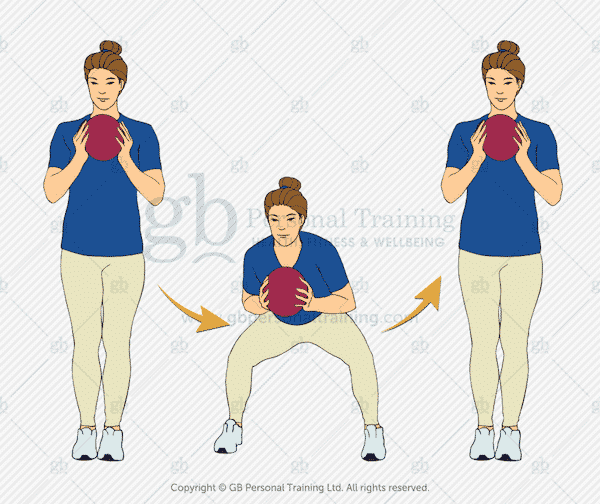
3 Medicine Ball Squat
Muscles used: Shoulders, Core, Glutes, Quads, Hamstrings, Hips Summary: One of the most important movement patterns, the squat can be performed by holding a medicine ball close to the chest throughout. Excellent for beginners because it acts as a nice counterbalance as you sit back onto your heels.
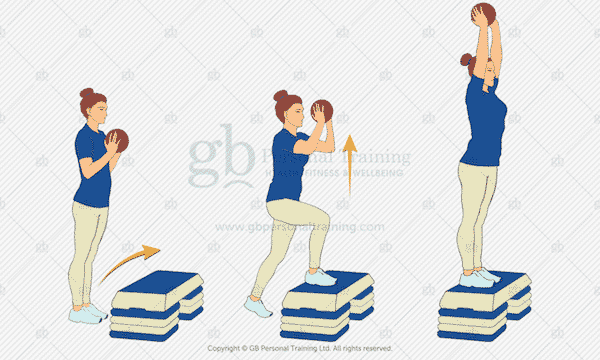
4 Medicine Ball Step Up and Press
Muscles used: Shoulders, Core, Glutes, Quads, Hamstrings, Hips Summary: A very practical and functional exercise that involves stepping up onto a box and then pressing overhead. Try to ensure you pull yourself up onto the box with your front leg rather then pushing from your rear leg. Try alternating legs or leading with the same leg each time.
5 Medicine Ball Squat and Lateral Step
Muscles used: Core, Glutes, Quads, Hamstrings, Hips Summary: Similar to the medicine ball squat exercise but this time you step to the side before descending into the squat. Slightly more challenging and cardiovascular. Try alternating sides when you step.
6 Medicine Ball Bob and Weave Exercise
Muscles used: Back, Core, Glutes, Quads, Hamstrings Summary: A great cardio movement for beginners as well as improving strength and flexibility in the hips. Many workouts forget to focus on lateral movements like this one but the benefits can be very rewarding especially for sports.
7 Medicine Ball Squat and Push
Muscles used: Shoulders, Core, Glutes, Quads, Hamstrings, Hips Summary: For this exercise we take the squat to a slightly more advanced level by adding in a forward chest press at the top of the movement. Be sure not to lean backwards during the chest press and keep your core tight and engaged throughout.
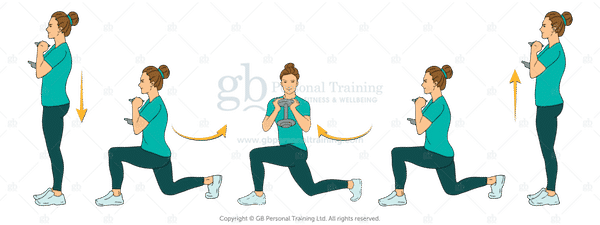
8 Medicine Ball Static Lunge
Muscles used: Glutes, Hamstrings, Core, Hips Summary: The lunge is a demanding movement but well worth the effort because it not only conditions the legs and buttocks but is also very cardiovascular. A great movement for improving your hip flexibility too.
9 Medicine Ball Overhead Squat
Muscles used: Back, Core, Glutes, Quads, Hamstrings, Hips, Shoulders Summary: This more advanced squat exercise will help to straighten out any squat alignment issues you may have as well as strengthening your entire body. Holding the medicine ball overhead also makes your heart worth harder as it has to pump blood all the way up to your hands.
10 Medicine Ball Lateral Step Up and Press
Muscles used: Shoulders, Core, Glutes, Quads, Hamstrings, Hips Summary: We have already worked on the regular step up, now we start to strengthen the hips with this lateral movement. Again make sure to pull yourself up with the front leg rather than pushing up from the rear leg.
11 Medicine Ball Cossacks
Muscles used: Back, Core, Glutes, Quads, Hamstrings, Hips, Adductors Summary: An excellent hip opening and strengthening exercise that is fun to perform. Keep your feet in the same position throughout the entire exercise. Start off steady and keep getting deeper into the movement with each repetition.
12 Medicine Ball Half Kneeling Press
Muscles used: Shoulders, Triceps, Core, Glutes Summary: You will need good balance and control as well as core strength and glute activation in order to perform this exercise correctly. Don’t allow yourself to arch at the lower back or for your buttocks to drift backwards. Stay strong and engaged!
13 Medicine Ball Clean and Press
Muscles used: Shoulders, Triceps, Back, Core, Glutes, Quads, Hamstrings, Hips Summary: A great functional exercise that simulates picking something up from the floor and placing it up and over your head. Almost all of your muscles are engaged throughout this movement. Be sure to keep a nice flat back as you pick up and lower the medicine ball.
14 Medicine Ball Reverse Lunge
Muscles used: Core, Glutes, Quads, Hamstrings, Hips Summary: One of the best exercises for strengthening and conditioning the buttocks and legs. Keep your chest up throughout the movement and work on pulling yourself up using the front leg.
15 Medicine Ball Single Leg Deadlift
Muscles used: Back, Core, Glutes, Quads, Hamstrings, Hips Summary: Develop strong hamstrings for sports and excellent balance with this exercise. Work on keeping your back nice and flat throughout the movement by keeping your chest up.
16 Medicine Ball Overhead Warm Up
Muscles used: Shoulders, Core, Glutes, Quads, Hamstrings Summary: A great intermediate exercise for warming up the lunge movement pattern. Keep the medicine ball overhead as you move from standing to the tall kneeling position. Use a mat to protect your knees!
17 Medicine Ball Forward Lunge
Muscles used: Core, Glutes, Quads, Hamstrings, Hips Summary: A slightly more challenging lunge variation than the reverse lunge exercise. Try to avoid rocking too far forwards by stepping first and then dropping straight down into the lunge position.
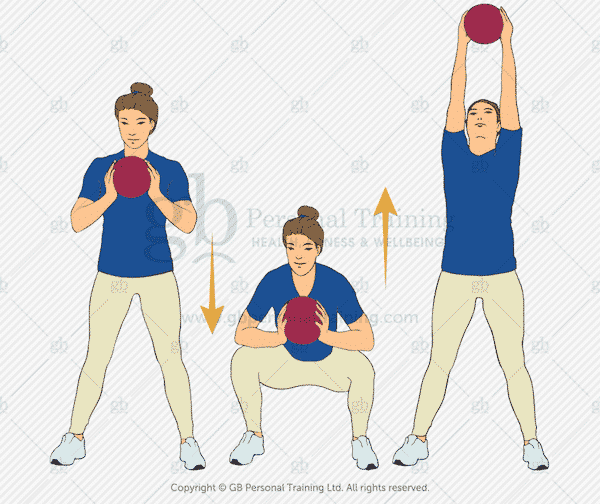
18 Medicine Ball Squat and Press
Muscles used: Shoulders, Triceps, Core, Glutes, Quads, Hamstrings, Hips Summary: Looking for a full body exercise that is also good for fat burning then this is the medicine ball exercise for you. Very cardiovascular! Ensure you have mastered the other squat variations before moving onto this one.
19 Medicine Ball Static Lunge and Press
Muscles used: Shoulders, Triceps, Core, Glutes, Quads, Hamstrings, Hips Summary: This lunge variation is surprisingly challenging on your balance as both feet should not move throughout the entire exercise. A good full body exercise and very cardio too.
20 Medicine Ball Squat and Rotational Press
Muscles used: Shoulders, Triceps, Core, Glutes, Quads, Hamstrings, Hips Summary: Another functional exercise that mixes a squat with a rotational press. Excellent for improving upper body mobility as well as conditioning the full body from head to toe. Alternate sides after each repetition.
21 Medicine Ball Overhead Forward Lunge
Muscles used: Shoulders, Back, Core, Glutes, Quads, Hamstrings, Hips Summary: An intermediate level lunge option that challenges the core muscles further as you have to try and stay tight to avoid lower back arching. Also more cardiovascular than the regular lunge as the heart must work harder to pump blood up to the hands.
22 Medicine Ball Push Up Single Hand
Muscles used: Shoulders, Triceps, Chest, Core Summary: You can challenge your shoulder stability and improve your single arm chest strength by performing a push up with one hand on a medicine ball. For this exercise you roll the medicine ball across and change hands each repetition.
23 Medicine Ball Lunge with Rotation
Muscles used: Upper Back, Core, Glutes, Quads, Hamstrings, Hips Summary: A tricky lunge variation that will challenge both your balance and mobility through your hips and upper back. Be sure to lunge first and rotate second rather than doing them both at the same time.
24 Medicine Ball Double Lunge
Muscles used: Core, Glutes, Quads, Hamstrings, Hips Summary: A really challenging exercise that overloads the one leg and buttock as well as raising the heart rate very quickly. For a more advanced variation try not to put your foot down as you move from forward lunge to reverse lunge.
25 Medicine Ball Chest Pass
Muscles used: Shoulders, Triceps, Core, Chest Summary: A dynamic medicine ball exercise that involves explosively pushing a medicine ball against a wall. You can also perform this exercise with a partner.
26 Medicine Ball Bulgarian Lunge
Muscles used: Core, Glutes, Quads, Hamstrings, Hips Summary: For single leg strength the Bulgarian lunge is a very good choice. Just raising the real foot off the ground makes a huge difference to the demands on the front leg and buttock. Careful not to raise the rear leg too high if your hip flexor flexibility is not too good.
27 Medicine Ball Push Up
Muscles used: Shoulders, Triceps, Core, Chest Summary: The instability of the medicine ball on the floor creates a great way to challenge your chest, arms and shoulders when performing a push up. Ensure the arms bend backwards along the body and the medicine ball is under the centre of the chest.
28 Medicine Ball Overhead Reach Reverse Lunge
Muscles used: Shoulders, Triceps, Glutes, Core, Hamstrings, Quads, Hips Summary: A dynamic lunge variation that challenges both strength, flexibility and cardio. As you step backwards into the reverse lunge reach up and backwards with the medicine ball. Keep your core muscles tight and engaged throughout to protect your lower back.
29 Medicine Ball Side Lunge
Muscles used: Back, Core, Glutes, Quads, Hamstrings, Hips Summary: You can improve your hip flexibility and develop strong buttocks and legs with this exercise. Great for sports! Make sure to keep your chest up and heels on the floor.
30 Medicine Ball Crescent Squat
Muscles used: Shoulders, Core, Back, Obliques, Glutes, Quads, Hamstrings, Hips Summary: You will need good coordination for this medicine ball exercise as you move in a crescent shape from a squat into the standing position. Don’t make the mistake of bending your lower back at the bottom of the squat position.
31 Medicine Ball Chopping Forward Lunge
Muscles used: Shoulders, Core, Obliques, Glutes, Quads, Hamstrings, Hips Summary: A excellent way to add a little more dynamic movement to your forward lunges. Chop down and across the front leg while keeping your chest up. You can perform this exercise walking forwards and alternating sides or keep repeating over the same leg.
32 Medicine Ball Overhead Front Slam Exercise
Muscles used: Shoulders, Lats, Core Summary: A dynamic core exercise that will take some practice to activate the core muscles correctly. Actively use the core muscles to pull you down as you slam the medicine ball to the floor.
33Medicine Ball Pistol Squat
Muscles used: Shoulders, Core, Glutes, Quads, Hamstrings, Hips Summary: One of the best single leg exercises to condition your mobility, strength and balance. Use the medicine ball to act as a counterbalance as you perform the exercise.
34 Medicine Ball Crescent Reverse Lunge
Muscles used: Shoulders, Core, Obliques, Glutes, Quads, Hamstrings, Hips Summary: An advanced lunge variation that takes the medicine ball up and over the head in a crescent shape during each repetition. Great for the core muscles and challenges your cardio too!
35 Medicine Ball Deck Squat
Muscles used: Shoulders, Back, Core, Glutes, Quads, Hamstrings, Lats Summary: A fun exercise that requires good hip mobility as well as strength in order to complete the movement. Use the medicine ball to propel you up from the bottom position.
36 Medicine Ball Overhead Throw
Muscles used: Shoulders, Lats, Back, Core Summary: Think of a soccer throw and you will understand the movement here. Challenging on the Lats and core muscles so be careful to warm up well and do not use a heavy medicine ball.
37 Medicine Ball Front Chop
Muscles used: Shoulders, Back, Core, Glutes, Quads, Hamstrings, Hips Summary: In many ways this medicine ball exercise is like the kettlebell swing. It can feel very strange at first but once mastered it is a very effective exercise for the entire body. Be sure to keep the chest up and hinge from the hips.
38 Medicine Ball Jumping Squats
Muscles used: Core, Glutes, Quads, Hamstrings, Hips Summary: Develop explosive power in your legs using this jumping squat exercise holding a medicine ball close to your chest. Definitely not one for beginners!
39 Medicine Ball Downwards Diagonal Chop Exercise
Muscles used: Shoulders, Back, Obliques, Core, Hips Summary: A challenging exercise that requires good body alignment throughout. Ensure to keep your chest up and lower back flat. As you chop down with force your body will have to absorb the movement which can leave you feeling sore (DOMS). Start with a very light medicine ball.
40 Medicine Ball Jumping Lunges
Muscles used: Core, Glutes, Quads, Hamstrings, Hips Summary: Develop explosive legs in the lunge movement pattern with this exercise. Definitely not one for the beginner and a good warm up needed beforehand. Very cardio too!
41
Medicine Ball Upwards Diagonal Chop Exercise
Muscles used: Shoulders, Back, Core, Obliques Summary: A very advanced exercise that requires good coordination otherwise it can feel “just weird”. Keep the core tight and engaged throughout. Be careful and use a very light medicine ball to practice.
Have you tried any of these Medicine Ball exercises? Let me know more below…
Big Bang exercises use as many muscles in the body as possible during each movement.
When you engage hundreds of muscles at a time the body requires larger amounts of energy to fuel the movement. The more energy required for the movement the more calories you burn.
If you are short on time or are looking for exercises to burn maximum amounts of calories then choosing from this list will really help.
A word of warning: Most of these exercises are NOT for the beginner.
They all involve complex movements that require good balance, coordination and strength.
Due to the complexity of these exercises they also involve huge amounts of neurological involvement, something that is often overlooked in program design.
So not only are they physically tiring but mentally tiring too!
I would advise you to choose just one of these exercises per workout and start off slowly.
OK, here goes…
# 1 – Cross Body Clean and Press
This exercise is best performed with a dumbbell. You need good mobility and lower back form in order to get this one right.
Start off with the dumbbell just in front of the left foot.
Next lean down with the right hand and Clean the dumbbell up to the right shoulder keeping your back flat and driving from the hips. Next press the dumbbell overhead.
Reverse the movement by bringing the dumbbell down to the shoulder and then across the body to the left foot again.
Just 10 reps of this exercise on each side is very demanding.
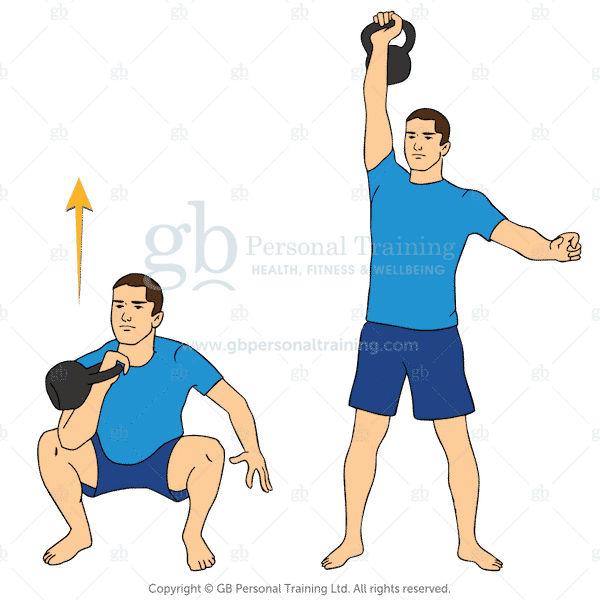
# 2 – Kettlebell Snatch
The Snatch is an explosive exercise that uses most muscles in the body but predominantly the ones in the legs and back.
Using one hand, swing the kettlebell between the legs as if performing a regular kettlebell swing.
When the kettlebell reaches head height pull the kettlebell towards you and then punch your hand up and through.
Reverse the movement by throwing the kettlebell out and then controlling it as it swings back through the legs.
If you are familiar with Barbell training then the Barbell Snatch could also be classed as a big bang exercise.
A great full body movement that you can performed with Dumbbells, Kettlebells, a Medicine Ball or a Barbell.
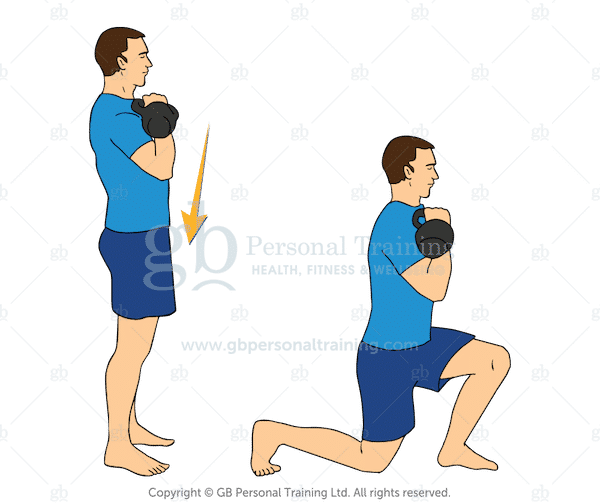
Holding the weight at shoulder height take a good step back into a reverse lunge and ensure that the back knee gets as close as possible to the ground.
Next pull forwards from the front heel and as you start to return to the start position drive the weight overhead.
Control the weight back down to the shoulders and repeat the movement using the other leg.
The side lunge is a very demanding exercise on its own but add a clean to the movement and you seriously know you’re exercising!
Step out wide with a Kettlebell or Dumbbell held at shoulder height.
As you step sideways drop the weight down towards the ground.
When you reach the bottom of the side lunge the arm should be straight.
Next drive back up to the start position and at the same time clean the weight back to shoulder height.
Keep your back flat throughout the whole movement.
# 6 – Thruster
The classic Crossfit exercise that connects the Squat with the Overhead Press.
It’s important that you take your time with this exercise.
Ensure that you reach at least parallel with your thighs to activate your Buttocks as well as using your upwards momentum to drive the weight overhead.
You can perform this exercise with any number of difficult pieces of equipment from Dumbbells, to Kettlebells to Powerbags, to Heavy Rocks!
One of my personal favourites because it not only works on balancing asymmetries between your left and right side but also requires good Mobility, Strength, Balance, Coordination, and Cardiovascular health.
Just try 5 – 10 reps of these on each side and feel how your heart rate starts to beat!
Holding one leg out in front of your drop down into a deep one leg squat.
Without letting your one foot touch the floor drive back up to the starting position.
To activate the shoulders and back hold a weight plate, medicine ball etc. out in front of you.
# 8 – Deadlift
The grandfather of full body movements.
Using a barbell push the hips backwards as you reach down to grab the bar.
Driving from your heels with your chest up and back flat return to a standing position.
Slowly return the bar to the ground and repeat.
Note that the deadlift is labelled a Deadlift because it is lifted from a dead position. So start each repetition from the ground.
Although you use huge amounts of hips and legs during the movement, the back, and upper back also get huge engagement. Try 5 sets of 5, then rest up for a few days!
Another variation of the Thruster but this one uses a Powerbag.
Start with the Powerbag on one shoulder and perform a deep squat.
Next drive up from the bottom of the squat and at the top position push the Powerbag up over your head and onto the other shoulder. Finally drop back down into the squat and repeat.
This exercise is a fast and cardiovascular movement that will leave any fitness enthusiast gasping for breath.
Try 20 reps.
# 13 – Clean, Squat and Press
A superb Kettlebell, Dumbbell or Barbell exercise that combines the popular Thruster exercise with a clean too!
The Clean movement adds more of a Deadlift type element so you get the benefit of more back engagement.
Begin by cleaning the weight to shoulder height before dropping into a deep squat and then driving up into an overhead press.
Finally take the weight back down to the ground before repeating the movement.
# 14 – Burpee Plus
Everyones favourite, the Burpee can be classed as a big bang exercise especially if you add a few extras.
To make the exercise more demanding you can add 1-3 push ups at the bottom of the burpee and a jump at the top of the movement.
I even like to encourage forward jumps or side jumps after each repetition.
# 15 – Walking Lunge with Rotation
A fun exercise that is highly demanding for the whole body.
Holding a medicine ball, dumbbell, powerclub, or weight plate begin with a forward lunge.
As you drop down into the lunge take the weight diagonally across the body from the shoulder and across the front knee.
Pull from the front heel and step up forwards.
Next repeat on the other side taking the weight across the opposite knee.
Continue walking forwards in this way.
Try 20 total reps or choose a marker to walk towards.
# 16 – Cable Push
You will need a cable machine or a resistance band for this exercise.
Stand with the right foot in front of you in a staggered stance and the weight behind you held in the left hand.
Now press the weight forwards rotating through the rear foot as you near the end of full extension.
Not only will you get heavy shoulder and chest engagement from this exercise but the core and legs work hard too!
# 17 – Cable Pull
The complete opposite of the Cable Push, this time pulling the cable towards you from a split stance.
Again rotate the body as the cable nears the end of the movement.
Ensure that you work the full range of movement during this exercise allowing the working side to fully extend and fully flex.
Maintain a tight core through the exercise and you won’t be disappointed!
Have you tried any of these exercises? Let me know more below:
This 500 Bodyweight Workout Challenge requires no equipment so you can take it with you anywhere.
Great for fat loss, developing movement skills, improving cardio and general conditioning.
Practice the exercises first and progress slowly, perhaps completing the challenge with only 10, 15 or 20 reps of each exercise.
When you are ready take on the challenge.
Record so far 11:31. And no it wasn’t me, my best time is 11:47. Enjoy!
You will need to take a days rest after completing the challenge.
Warning: if you are a complete beginner then some of these exercises are not for you, please use the alternative exercises listed beneath each exercise.
1. Fast Mountain Climbers (50 reps each leg)
Easier Exercise: Don’t jump to alternate the legs at the same time. Instead alternate placing each foot forwards and then backwards.
Watch a tutorial video of the Fast Mountain Climbers:
2. Jump Squats (50 reps total)
Easier Exercise: Replace this exercise with regular Y Squats, shown for exercise #6.
Watch a tutorial video of the Jump Squats Exercise:
3. Push Ups (50 reps total)
Easier Exercise: Make the push up easier by performing them off a wall or bench.
Watch a tutorial video of the Push Up Exercise:
4. Cossacks (25 reps each side)
Easier Exercise: Hold onto the back of a chair or wall in order to help control the movement better.
Watch a tutorial video of the Cossacks Exercise:
5. Slow Mountain Climbers (25 reps each side)
Easier Exercise: Hold the plank position either on your hands or on your forearms, or lightly touch the toes down by the side of the hands.
Watch a tutorial video of the Slow Mountain Climbers Exercise:
6. Y – Squats (50 reps total)
Easier Exercise: Hold onto a wall or back of a chair to help stabilise yourself during the squat movement.
Watch a tutorial video of the Y Squat Exercise:
7. Forwards Lunges (25 reps each side)
Easier Exercise: Use a broomstick to help support you during the movement or place one hand against a wall.
Watch a tutorial video of the Forward Lunge Exercise:
8. Squat Thrusts (50 reps total)
Easier Exercise: Don’t jump forwards and backwards instead alternate placing one foot forwards and then backwards again.
Watch a tutorial video of the Squat Thrust Exercise:
9. Dirty Dogs (25 reps each side)
Easier Exercise: You can either just bend up and down, repeating what they call in yoga the up dog and down dog position. You can also stop when your body reaches a straight line or is in the top push up position.
Watch a tutorial video of the Dirty Dogs Exercise:
10. Burpees (50 reps total)
Easier Exercise: Rather than jump both feet back at the bottom of the squat movement just place your hands on the floor and step backwards and then forwards with both legs.
Watch a tutorial video of the Burpee Exercise:
How did you get on? I’d love to hear your comments below:
I guess for many people Kettlebell Training may be how you first discovered me. I was one of the first to introduce Kettlebell Classes into London and still teach Kettlebells to this day.
Kettlebells are a very powerful tool that can be extremely effective but they can also be hugely ineffective if abused.
In today’s post I’m going to lay out exactly how you should approach Kettlebell Training to get the most benefits from it while minimising injury at the same time.
History of Kettlebells
If you have not seen or heard of kettlebells before then allow me to give you a very quick overview.
A kettlebell is a solid heavy ball with an offset handle just large enough to place your hand through.
The origins of the kettlebell are a little vague but they can be traced back hundreds of years.
Weights with handles were often used during fitness challenges for both carrying and throwing events and it’s believed that the kettlebell simply evolved from here.
Later the Kettlebell was adopted by the Soviet forces for training their soldiers and then finally gained popularity in the west.
Benefits of Kettlebell Training
Kettlebells are a tool just like any other piece of fitness equipment, they can be used correctly or they can be used incorrectly.
The kettlebell is pulled, pushed, and swung in a dynamic nature causing excessive demands on the body.
Here are 7 benefits of kettlebell training:
Offset Handle enables swinging of the kettlebell
Kettlebell Swinging increases the load and so increases the demands required to decelerate the kettlebell
Swinging increases the demand on stabilisation muscles as they work harder to keep joints aligned
Swinging the Kettlebell increases Lunge and Heart Capacity as multi-joint movements require more oxygen
Kettlebell Swinging requires no movement of the feet meaning a Full Body workout requiring little workout space
Kettlebell Exercises involve full body movements connecting head to toe and improving core integration
Regular Kettlebell Training increases ligaments and soft tissue strength due to the dynamic movements
Selecting the Correct Kettlebell
Since Kettlebells have become popular in gyms and with personal trainers, more and more companies have started selling them.
Be careful!
Not all kettlebells are created equal.
Here’s a quick guide to buying your first kettlebell:
Competition Kettlebells
These kettlebells have a more square handle and the body of the kettlebell stays the same size regardless of the weight.
These bells are designed for competition and the narrow handle enables minimum movement of the hand inside the handle.
These kettlebells are great for single handed exercises but for the beginner they offer little room to hold the kettlebell with two hands.
Cast Iron Kettlebells
These are my kettlebell of choice, they have a slightly rounded handle and a solid cast iron ball.
The kettlebell should be smoothly shaped and have no sharp corners.
The space between the handle and the ball should be just large enough to push a horizontal closed fist through but not so large that you can push a vertical closed fist through.
Types of Kettlebells to Avoid
Anything that is made of vinyl, I haven’t seen a good one yet!
Any Kettlebell with a flat plastic or rubber foot attached to the bottom
Kettlebells with very large handles, use the fist test as detailed above
All Kettlebells that have sharp corners, lines or edges
Selecting the correct kettlebell is vital as you will find out when you start training.
Badly designed kettlebells will destroy your wrists, band up your forearms and seriously reduce the pleasure of your training.
Kettlebells traditionally come in a number of different weights, here’s my guide to what weight to use:
8kg or 17lbs – Starting Weight for Women, I’ve never trained a women who shouldn’t start here. Remember this isn’t Dumbbell training!
12kg or 26lbs – Unconditioned Men start here and Women advance to here very quickly
16kg or 36lbs (Original Weight) – Average Conditioned Men start here, and many women progress to this weight within 6-12 months
20kg or 44lbs – A natural progression for men and some women use this for Swings
24kg or 52lbs – (Original Weight) – This is the goal for men and a nice demanding weight for most exercises.
28kg or 61lbs – It’s a big leap from 24kg to 32kg so this can help bridge the gap.
32kg or 70lbs – (Original Weight) – I like this weight for Swings and Turkish Get Ups
Due to the increased popularity of kettlebell training many manufacturers have started to produce smaller and interim weight sizes. Stick to the weights above and I’m sure you will find you don’t need any other sizes.
Most men can survive with just a 16kg kettlebell for some time and most women can benefit from an 8kg and a 12kg.
Where to Start – Level 1 (Stabilisation)
Most people jump in and start with kettlebell exercises that are way too advanced for them and end up getting injured or developing bad habits.
As with everything in life we need to start off with the basics and build a strong foundation.
The human body is built from Stabilising Muscles and Prime Mover muscles.
Our stabiliser muscles are smaller and weaker but better at endurance work, they stabilise the joints enabling a strong platform for the larger muscles to work from.
The Prime Mover muscles are larger muscles and they provide the large movements, the quads are a great example.
Due to our current sitting lifestyles and the advent of weight training machines most of us have very badly conditioned stabiliser muscles meaning that our big muscles work but on a very shaky foundation.
So, in order to build a solid foundation and avoid injury we need to work on the stabiliser muscles first.
Here are 2 kettlebell exercises that every one should master before moving on:
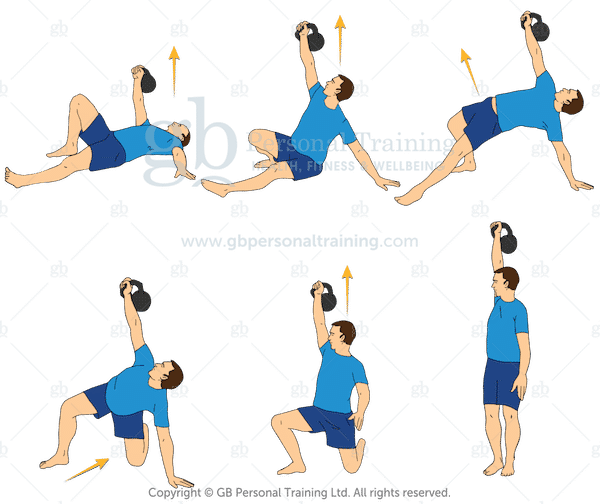
# 1 – Kettlebell Turkish Get Up
The Turkish Get Up is a full body exercise that takes you through most of the fundamental movement patterns conditioning your core and stabiliser muscles in the process.
The Turkish Get Up is probably one of the best all over body stabilisation exercises and has been around for hundreds of years.
It is believed that the Greeks would NOT train a boy with weights until he could get up from the floor with a weight held above his head.
This concept mirrors my philosophy that we should not be training with any resistance until we have a strong enough stabilisation system to deal with it.
The Turkish Get Up involves 7 stages:
From the Fetal position roll onto your back and help the bell into the straight arm position. Don’t take your eyes off the bell
Bend the leg on the same side as the bell and place the opposite arm out at 45 degrees
Crush the handle as you sit up along the line of your arm, first to elbow and then to hand. Keep the kettlebell arm down and in its socket and the opposite shoulder away from the ear
Push from the heel of the bent leg and drive your hips in the air and into full hip extension. There should be a straight line from bell to bottom hand
Sweep the straight leg back and through to a half kneeling position
Taking the hand off the floor straighten the body and take the eyes off the bell and look forwards
Drive from the front heel and stand. Steady yourself and then reverse the movement
Now you have an understanding of the two fundamental kettlebell exercises that I recommend for improving the stabilising muscles, let’s put them together into a monthly workout program.
Week 1 – Practice Week
Monday: Turkish Get Up (No Kettlebell) – 10 reps, 5 each side
Tuesday: Single Leg Deadlift (No Kettlebell) – 5 reps each side x 2 sets
Wednesday: Turkish Get Up (No Kettlebell) – 5 reps each side x 2 sets
Thursday: Single Leg Deadlift (No Kettlebell) – 5 reps each side x 2 sets
Friday: Turkish Get Up (Holding Glass Water) – 5 reps each side x 2 sets
Saturday: Single Leg Deadlift (No Kettlebell) – 5 reps x 3 sets
Sunday: Rest
Week 2 – Adding Load
Monday: Turkish Get Up (Holding Glass of Water) – 5 reps each side x 3 sets
Tuesday: Single Leg Deadlift (With Kettlebell) – 5 reps each side x 2 sets
Wednesday: Turkish Get Up (Holding Glass of Water) – 8 reps each side x 2 sets
Thursday: Single Leg Deadlift (With Kettlebell) – 8 reps each side x 2 sets
Friday: Turkish Get Up (With Kettlebell) – 3 reps each side
Saturday: Rest
Sunday: Rest
Week 3 – Combining Exercises
Monday: Turkish Get Up (With Kettlebell) – 5 reps each side
Tuesday: Single Leg Deadlift (With Kettlebell) – 5 reps each side x 3 sets
Wednesday: Rest
Thursday: Single Leg Deadlift (With Kettlebell) – 5 reps each side x 2 sets
Follow With:Turkish Get Up (With Kettlebell) – 3 reps each side
Friday: Rest
Saturday:Single Leg Deadlift (With Kettlebell) – 8 reps each side x 2 sets
Follow With: Turkish Get Up (With Kettlebell) – 5 reps each side
Sunday: Rest
Week 4 – Progressing
Monday:Single Leg Deadlift (With Kettlebell) – 5 reps each side x 3 sets
Follow With: Turkish Get Up (With Kettlebell) – 3 reps each side x 2 sets
Tuesday: Rest
Wednesday: Single Leg Deadlift (With Kettlebell) – 5 reps each side x 3 sets
Follow With:Turkish Get Up (With Kettlebell) – 5 reps each side x 2 sets
Thursday: Rest
Friday:Single Leg Deadlift (With Kettlebell) – 5 reps each side x 3 sets
Follow With:Turkish Get Up (With Kettlebell) – 3 reps each side x 3 sets
Saturday: Rest
Sunday: Rest
The objective of the above 4 week program is to build skill and confidence with the movements.
The movements should be challenging but not too hard.
The hard workouts come later.
Take your time, be consistent and build beautiful movement patterns.
You will really benefit from this in the long run.
Don’t cut corners or think you are too cool for these short workouts, get great at the finer details.
If you find the above workout plan too challenging then continue to repeat each week until you feel you are ready to move on.
Dynamic Kettlebell Training – Level 2
You should now have bomb proofed your body ready for more dynamic kettlebell exercises.
Here is where you start to work a little harder and really feel the benefits of the ballistic movements of the kettlebell.
Again I have to warn you.
Just as quickly as a kettlebell can improve your body it can undo it just as fast.
If you haven’t mastered the Single Leg Deadlift or the Turkish Get Up then you need to do that first!
Here are the 3 Fundamental Kettlebell Exercises that take advantage of the fundamental movement patterns that we are all designed to use anatomically…
# 1 – Kettlebell Two Handed Swing
The first and by far the most characteristic kettlebell exercise is the Kettlebell Swing.
The Swing involves the deadlift pattern or hinging at the hips.
During this exercise you will activate almost every muscle in your body and in particular the posterior chain or back line of the body.
Kettlebell Swings are highly effective at raising your heart rate, improving your posture and building strength endurance.
Here are my tips for the Kettlebell Swing:
Hinge at the hips NOT the lower back
Stand Tall and Squeeze your Abs & Buttocks
Load the heels NOT the toes
Maintain a Flat Back through the exercise
Lift the Chest and keep the Shoulders in their sockets
Ensure the shins track the line of the feet
Breathe OUT on the way down and IN on the way up
Here’s a Video Tutorial of the Kettlebell Swing:
I would recommend that you start with the two handed Swing first and then progress to the one handed swing later.
The movement principles are exactly the same between the two exercise you just hold the kettlebell with both hands rather than one.
As you enter the bottom of the Kettlebell Swing and your pelvis rotates forwards your hamstrings will be on stretch.
If you have tight hamstrings due to Core Activation discrepancies, injuries or lack of movement skills, then your lower back will start to arch to assist you in the depth of the swing.
It is VERY IMPORTANT that you do not let this happen.
You must adjust the depth of your Swing so that your Hamstrings DO NOT over stretch at the bottom portion of the swing.
If you have problems touching your toes or know that you have tight hamstrings when you lean forward then DO NOT swing too deep or far between your legs. Keep your swings shallow!
# 2 – Kettlebell Goblet Squat
We all know that the Squat is an incredible and extremely natural movement pattern.
Like the Swing it uses most muscles in the body and helps up sit down and stand up from a chair, toilet etc.
Once you have mastered the Bodyweight Squat then you can perform a Kettlebell Squat.
There are 2 basic holding positions for the Squat, either with both hands or with just one hand.
If you hold the Kettlebell with just one hand then you load one side of the body encouraging additional stabilisation to centralise the movement.
Here are my tips for the Kettlebell Squat:
Load the heels and the back of the body
Ensure Shins align with the line of the feet
Sit the hips back as if in Ski Boots
Keep your Chest Up as you hold the Kettlebell
Keep your Shoulders back and Back Muscles Engaged
Push the ground away from you as you drive up through your heels
Now you have 3 new kettlebell exercises that you can add to your workouts. Dynamic Kettlebell Exercises are much more challenging so we have to be careful with recovery times.
Here is a monthly workout plan for you to try:
Week 1 – Acclimatisation
Monday: Two Handed Kettlebell Swing – 20 secs / 30 secs rest x 3
Tuesday: Two Handed Kettlebell Reverse Lunge – 30 secs / 30 secs rest x 3
Wednesday: Rest
Thursday: Two Handed Kettlebell Swing – 20 secs / 30 secs rest x 3
Friday: Two Handed Kettlebell Squat – 30 secs / 30 secs rest x 3
You will notice that all Kettlebell exercises above are Two Handed.
I recommend this format for the first 4 weeks.
As your movement and strength improves then you can move onto single handed exercises.
I’ve kept the format very simple.
Again, don’t be too impatient, stick to the program, you are using a lot of muscle mass during each workout so don’t overdo it.
If you find that the workout is too much then either reduce the time, increase the rest or reduce the amount of sets.
Most of all practice the movements and perfect your technique.
Advanced Kettlebell Exercises – Level 3
Even if you only practiced and used those 5 exercises that I have described you could get fitter, stronger and move better than 99% of the gym population.
But there is more, a lot more that you can learn.
Here are 3 more exercises that you can add to your Kettlebell Toolkit to really supercharge your workouts when you are ready:
# 1 – Kettlebell Clean
This is the next progression on from the Kettlebell Swing.
Once you have mastered both the Single Handed Swing and the Double Handed Swing, Squat and Lunge then this should be next on your list.
The Clean takes the Kettlebell from the floor and places it into the racked position in the ‘V’ of your arm.
From this position you then have the option to Press the Kettlebell, Squat, or Lunge.
Of all the Kettlebell Exercises this is the most technical for some and many end up with bruised wrists or forearms.
Using the correct shaped kettlebell and keeping the bell close to the body will certainly help improve your skill.